A Left Bank reading room that stayed open after midnight and started pulling espresso shots — Sylvia Beach's Shakespeare & Company if it had been designed by a Milanese furniture maker instead of a hoarder.
- Intellectual without being elitist — everyone is reading something, no one is performing erudition
- European heritage without nostalgia — the warmth of old Paris but not cosplaying the 1920s
- Evening intimacy without nightclub energy — low light and jazz but you could still read Proust if you wanted
- Curated without being precious — the book selection matters but you're allowed to order just a coffee
“You'd recognise it by the long tables where serious work accumulates—not styled clean between customers but allowed to sediment like a designer's desk by 9am, the room smelling equally of espresso and old paper.”
Maison Hibou is the Left Bank reading room that never closed—walnut tables claimed at dawn by novelists and designers who measure their day in espresso cups and pencil shavings, not productivity metrics. The brand lives in the archaeology of creative work: flour dust catching late light through tall windows, marginalia accumulating in used Gallimard editions, brass banker's lamps pooling amber over open notebooks. Sabon headlines anchor like letterpress, Akkurat body text holds the page with typographic restraint, P22 Operina marks the menu like a scholar's annotation. Voice moves like margin notes—short declarative sentences that name the exact thing (4B graphite, Clairefontaine grid paper, the 1957 pressing) without performing erudition. The palette pulls from materials mid-life: sunwashed ochre plaster, notebook teal spines, paprika accent like bookcloth, worn walnut grain, lamp brass neither polished nor fully tarnished. Documentary photography shot wide in golden hour, embracing grain and the small beautiful mess of work-in-progress. Hospitality as infrastructure—we hold the table, tend the light, trust you to bring the rest.
- Brass banker's lamp pooling amber light across open notebook and cooling espresso cup
- Walnut table grain with accumulated evidence—wax drips, cup rings, pencil shavings in crevices
- Flour dust suspended in shaft light above warm kouign-amann on parchment paper
- Marginalia in used Gallimard paperback, previous reader's annotations in faded ink
- Linen napkin beside newsprint, both catching sidelight texture—weave and tooth rendered equal




We write like margin notes in a well-loved Gallimard edition—short declarative sentences that name the exact thing (4B graphite, kouign-amann from Brittany, the 1957 pressing) instead of gesturing vaguely at 'quality' or 'craft.' Conversational erudition: we assume you know what we're talking about, but if you don't, the specificity itself is inviting—you learn the vocabulary by context, like overhearing a good conversation at the next table.
- +Name the specific thing—never 'pastry,' always kouign-amann
- +Use short sentences that land like facts
- +Let sensory detail do the work—ochre light, graphite smudge
- +Write in present tense, active verbs
- +Assume the reader is curious and literate
- +One-sentence paragraphs are valid
- –Never start with 'We believe' or 'At Maison Hibou'
- –No exclamation marks or hype words
- –Don't explain the metaphor—trust it
- –Avoid 'artisanal' 'curated' 'authentic' 'passion'
- –No questions to the reader
- –Never describe the vibe—show the detail instead
Logos, palette, fonts, voice, positioning, audience.
“You'd recognise it by the long tables where serious work accumulates—not styled clean between customers but allowed to sediment like a designer's desk by 9am, the room smelling equally of espresso and old paper.”
What this brand really is
A Left Bank reading room that stayed open after midnight and started pulling espresso shots — Sylvia Beach's Shakespeare & Company if it had been designed by a Milanese furniture maker instead of a hoarder.
Sage because this is fundamentally a knowledge sanctuary — books as the core offering, the owl as mascot, the promise of contemplation. Caregiver secondary because it's explicitly about hospitality (long shared tables, warmth, welcoming both students and established writers) — not the ivory tower but the hearth.
Maison Hibou began in 2011 when a rare-book dealer inherited a narrow corner building on rue de Verneuil and couldn't decide between opening a reading room or a café—so she built both, installing a La Marzocco between the philosophy stacks and commissioning walnut tables long enough that strangers became collaborators by proximity. The owl, carved into the building's 18th-century lintel, became our quiet mascot: watchful, nocturnal, at home in both solitude and lamplight.
“A sanctuary where serious work and genuine hospitality coexist—we hold the table, tend the light, and trust you to bring the rest.”
What we believe
We hold space for the city's makers — writers mid-draft, artists between commissions, anyone who needs a corner table and won't be rushed.
We occupy the gap between the polished specialty café (performance space for latte art) and the coworking warehouse (productivity theatre with hot-desks). Maison Hibou is the third space that doesn't meter your time or curate your presence — you claim a corner at dawn with your notebooks and no one clears your table until you're done. We compete on creative atmosphere, not efficiency metrics or Instagrammable moments; our regulars build small civilizations of coffee cups by 9am and the margins fill with sketches by evening.
- Intellectual without being elitist — everyone is reading something, no one is performing erudition
- European heritage without nostalgia — the warmth of old Paris but not cosplaying the 1920s
- Evening intimacy without nightclub energy — low light and jazz but you could still read Proust if you wanted
- Curated without being precious — the book selection matters but you're allowed to order just a coffee
- Shared tables without forced conviviality — communal seating that permits solitude
Who we're for
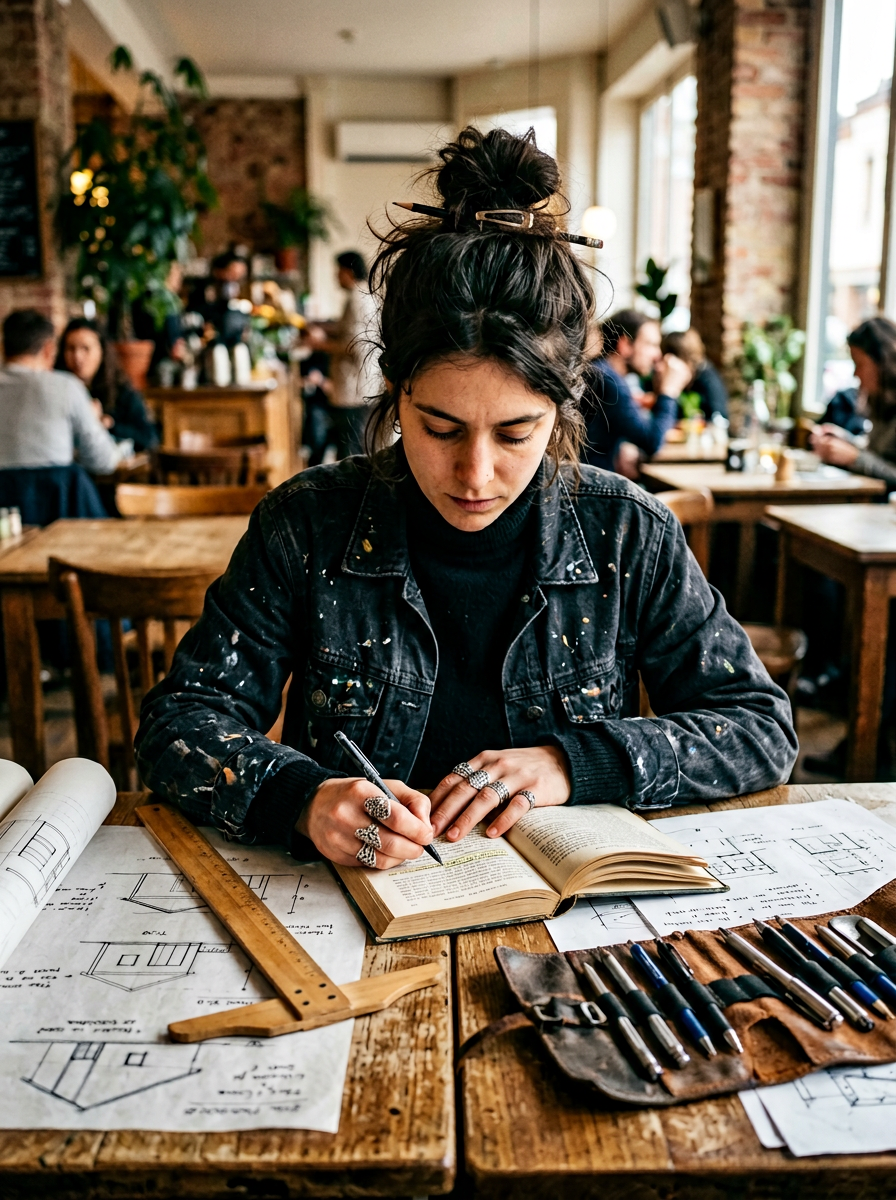
Freelance designers and early-draft novelists in their late twenties to mid-forties who've turned the corner table into a second office, arriving with tote bags heavy with library books and leaving behind pencil shavings. They're the ones who know which seat gets the best morning light and have a standing pastry order by name.
26–45, €25k–65k annual income, urban European capitals and university districts
Value sustained attention over productivity theater. Believe good work requires ambient human presence but not conversation. Suspicious of corporate co-working's forced energy, drawn instead to places that permit long silences. Fear both isolation and interruption in equal measure.
- Arrives before 8am to claim the window table, orders a single coffee that lasts three hours
- Brings own notebook systems — dot-grid Leuchtturms, fountain pens, research printed on recycled paper
- Marks pages with coffee rings and crumbs, treats tables as working surfaces not showrooms
- Photographs light falling on their setup but never posts it — the documentation is private ritual
- Knows staff by name, leaves exact change, respects the unspoken reservation system of regulars
- Stays through multiple menu cycles, orders lunch without looking up from the manuscript
- To be the kind of person whose work requires this level of sustained attention
- To belong to a place that knows their order without asking
- To produce something worth the hours spent staring at the grain of the table
How we sound
We write like margin notes in a well-loved Gallimard edition—short declarative sentences that name the exact thing (4B graphite, kouign-amann from Brittany, the 1957 pressing) instead of gesturing vaguely at 'quality' or 'craft.' Conversational erudition: we assume you know what we're talking about, but if you don't, the specificity itself is inviting—you learn the vocabulary by context, like overhearing a good conversation at the next table.
Margin notes in a well-loved edition—conversational erudition that names the exact thing (kouign-amann from Brittany, Leuchtturm, 4B graphite) and teaches vocabulary through overheard specificity, never lecturing.
“The lamp stays on until the last page is turned.”
“Tables for work that takes time”
“The house edition is Illy pulled through a Faema E61—short, no sugar, in a Duralex Picardie that catches lamplight at the base. Served with a square of Valrhona 70% on the saucer, not for sweetness but for the ritual. By 9am most tables have three empty cups forming a small terracotta skyline.”
“Someone left Ferrante face-down on the walnut near the lamp, margin notes in faded Muji 0.38.”
“Hold the table”
“Brass lamps pool amber over open work; the espresso stays hot long enough to finish the paragraph.”
- Name the specific thing—never 'pastry,' always kouign-amann
- Use short sentences that land like facts
- Let sensory detail do the work—ochre light, graphite smudge
- Write in present tense, active verbs
- Assume the reader is curious and literate
- One-sentence paragraphs are valid
- Never start with 'We believe' or 'At Maison Hibou'
- No exclamation marks or hype words
- Don't explain the metaphor—trust it
- Avoid 'artisanal' 'curated' 'authentic' 'passion'
- No questions to the reader
- Never describe the vibe—show the detail instead
How we look
Golden-hour documentary of creative archaeology—walnut grain under banker's lamps, flour dust in backlight, the honest patina of brass and book spines mid-life, shot wide with gentle grain and rich blacks.
- Brass banker's lamp pooling amber light across open notebook and cooling espresso cup
- Walnut table grain with accumulated evidence—wax drips, cup rings, pencil shavings in crevices
- Flour dust suspended in shaft light above warm kouign-amann on parchment paper
- Marginalia in used Gallimard paperback, previous reader's annotations in faded ink
- Linen napkin beside newsprint, both catching sidelight texture—weave and tooth rendered equal
See the hero above for the palette, type specimens, and moodboard that follow from this philosophy.
Where we sit
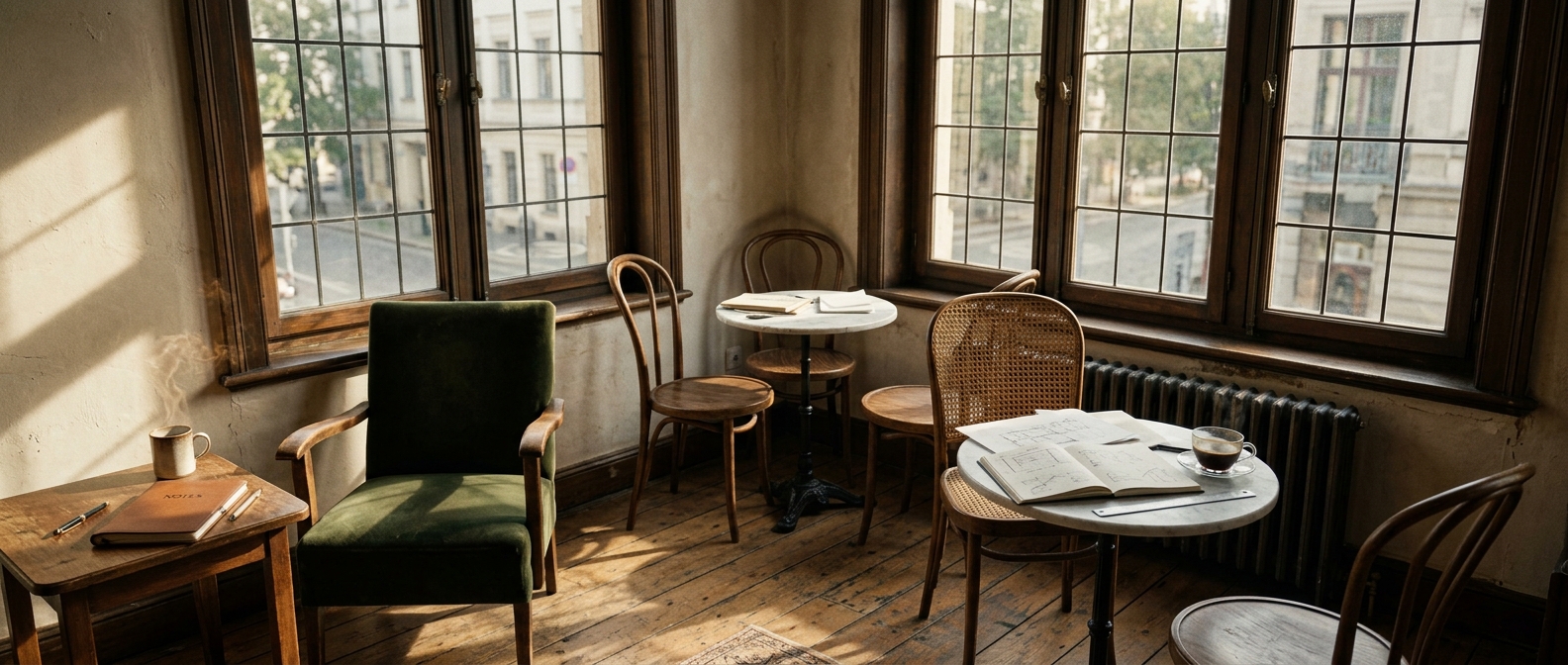
- Warm lighting as identity — café interiors should photograph amber, not stark white
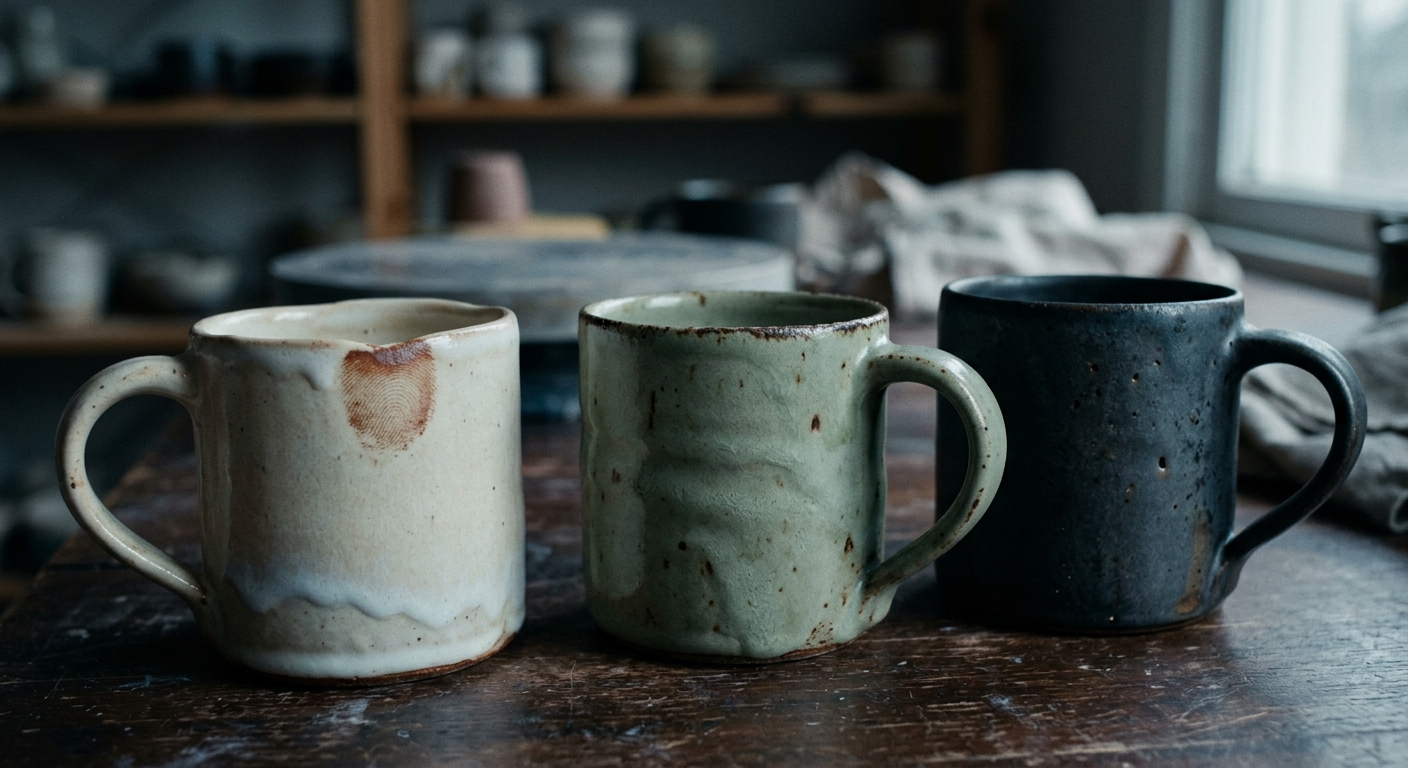
- Tactile materials visible in every image — wood grain, paper texture, patina on brass
- Menu or book list typography that feels considered, not hasty
- The Edison-bulb Brooklyn coffee aesthetic — no exposed brick or industrial piping
- Precious minimalism — this is not Kinfolk magazine, tables should look lived-on
- The 'quirky bookshop' cliché of stacks everywhere and no breathing room — this place has architectural order
- The Kinfolk / Cereal Magazine washed-out latte-art photography
- Script fonts or faux-vintage letterpress effects — this is not a speakeasy
- The quirky illustrated owl — if there's an owl mark it should feel more engraved cipher than Etsy charm
- Chalkboard menus with forced-casual handwriting
- Any visual reference to typewriters, vinyl records as decor props, or mason jars
What we offer
Maison Hibou is an all-day café and creative sanctuary where serious coffee, pastries crafted with French technique, and curated artist books converge under floods of natural light. More workshop than showroom, we provide the infrastructure for creative work—communal tables claimed by regulars at dawn, shelves of zines and art publications for browsing, and the kind of bohemian permanence where your corner becomes yours.
“The communal table experience—claimed at dawn by creatives who build small civilizations of coffee cups and notebook chaos, becoming regulars not through loyalty programs but through the quiet claim of presence.”
- 01Third-wave espresso program with rotating single-origin beans
- 02Laminated pastries (kouign-amann, croissants, pain au chocolat)
- 03Tartines and seasonal open-faced sandwiches
- 04Artist books, zines, and independent publications for sale
- 05Communal worktables with natural light and electrical access
- 06Light lunch menu (soups, salads, cheese plates)
- 07Weekend jazz sessions in evening hours
- 08Cork board community exchange for postcards and notes